Category Archives: Uncategorized

Water Commissioners’ New 2015 Terms

Long Island voters in 21 Commissioner-run Water Districts have voted to elect or reelect Water Commissioners in Nassau and Suffolk Counties.  The NSWCA welcomes the new Commissioners who will serve three-year terms beginning January 1, 2015 and running through December 31, 2017.  Elections are held annually.  Commissioner-run Districts enable residents to express preferences through the voting process on a hyper-local basis. The NSWCA congratulates the following on their elections:

Albertson:                      Richard Ockovic

Bethpage:                      John R. Sullivan

Carle Place:                    Lawrence F. Zaino Jr.

Cathedral Gardens:      Ray Rockensies

Franklin Square:           Salvatore A. Intagliata

Garden City Park:          Peter Chimenti

Glenwood:                     Kenneth S. Uihlein

Greenlawn:                    William M. Wieck

Hicksville:                     William Schuckmann

Jericho:                         Anthony J. Cincotta

Locust Valley:                Pasquale J. Eliseo

Manhasset-Lakeville:      Mark Sauvigne

Massapequa:                 Thomas P. Hand

Oyster Bay:                  Robert J. McEvoy

Plainview:                     Marc B. Laykind

Port Washington:            Peter Meyer

Roslyn:                          William K. Costigan

South Farmingdale:         Ralph Atoria

South Huntington:           Ciro DePalo

Westbury:                      William C. Olson

West Hempstead:           Kenneth P. Wenthen, Jr.

LIWC 2014 Photos

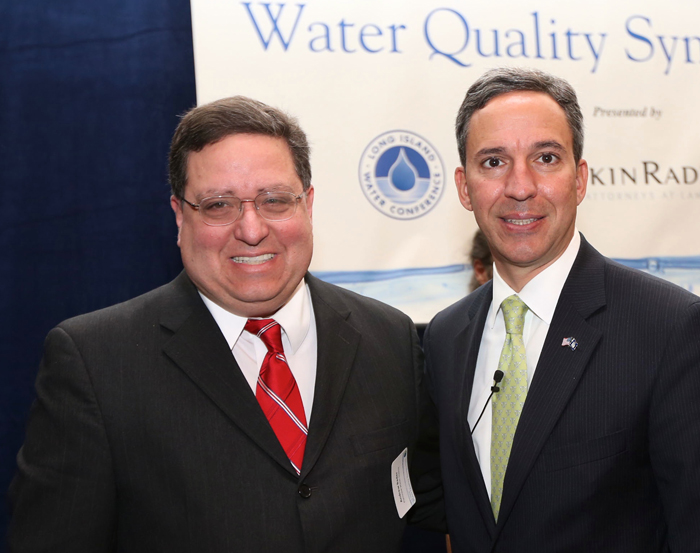
bader_martins

Commissioner Andy Bader, NY State Senator Jack Martins

bader_bellone

Commissioner Andy Bader, Suffolk County Executive Steve Bellone

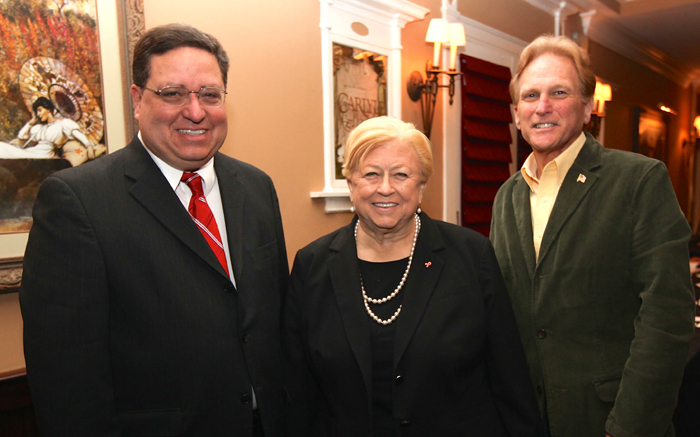
bader_jacobs

Commissioner Andy Bader, Nassau County Legislator Judy Jacobs, Commissioner Howard Abbondondelo


Meeting With PSEG Gets Into The Knitty Gritty

Farmingdale, NY – The Nassau Suffolk Water Commissioners’ Association (NSCWA) recently welcomed speakers from Long Island’s electric utility, Public Service Enterprise Group (PSEG), as part of the Association’s ongoing Educational Series. Robert Hughes, PSEG Account Manager, along with colleagues Domenic R. Abbatiello, C.E.D., E.D.F.P., Manager of Large Consumer Support & Critical Facilities, and Robert Ganley, Manager Compliance, introduced the company.  The discussion included PSEG’s history, five-year action plan and management structure as relevant to critical facilities.

“Customer satisfaction begins with enhanced communication services for the public and civic organizations,” said Mr. Hughes.  “PSEG has implemented a proven communications model which includes enhanced training and response, a state-of-the-art call center and self-grading system.

“The NSWCA applauds PSEG’s strategy for communication,” stated Howard Abbondondelo, NSWCA President and Albertson Water Commissioner.  Accurate, complete information is vital to the safety of the public and our working crews.  Trust is built through communication and transparency, particularly in times of emergency.”

NSWCA commissioners wasted no time in using this opportunity to open dialogue with PSEG. Lawrence Zaino, Commissioner from the Carle Place Water District, addressed the “hurricane poles” installed along some of Long Island’s coastal communities.  These 65-70 foot poles bolster the power grid where residents have expressed safety and aesthetic concerns.

Karl Schweitzer, Commissioner from the Hicksville Water District, vocalized trepidation over new utility poles preservatives. “Chemicals on the poles can negatively affect the environment and potentially the water table,” Mr. Schweitzer said.  He continued by asking about environmental studies and alternatives explored by PSET.

PSEG’s Domenic Abbatiello advanced no resolutions but welcomed the opportunity for further discussion with the NSWCA and the community at large, in hopes of finding a solution that is both economical and viable.

“Maximizing our water budgets and remaining the least expensive of utilities is a mission of NSWCA commissioners,” stated Carle Place Water District Commissioner Tim Stellato. Mr. Stellato inquired about whether or not water districts can use energy efficient programs to sell power back to the grid, aiding the environment and saving the community money.

“If an energy efficient program makes sense, PSEG will assign a rebate to it,” responded   Mr. Hughes assured.

The September meeting served as preface to future dialogues between the NSWCA and PSEG.  Plans for continued communications will improve the safety, efficiencies, cooperation and service of Long Island’s public utilities.

Hurricane Preparedness Taken To Heart By Nassau Suffolk Water Commissioners’ Association

Melville, NY USA – As part of an ongoing commitment to ensure the safety of water supply operations in all member districts, The Nassau Suffolk Water Commissioners’ Association (NSWCA) attended the recent Hurricane Seminar held at the Morrelly Homeland Security Center Bethpage NY.  Deputy Commissioner Leonard B. Symons of the Town of Oyster Bay presided.

The seminar focused on effective planning for potentially catastrophic events like Superstorm Sandy and Hurricane Irene. Of particular interest to the NSWCA were discussions regarding the improvement of forecasting and outreach, including partnerships with national, state and local emergency operation centers.

“Long Island is vulnerable to storms because of its geography,” said Commissioner Richard P. Niznik of the Oyster Bay Water District.  “No one knows what Mother Nature will bring.  The seminar information indicated that the hurricane prediction for 2014 is anywhere from eight to thirteen named storms.  The relative severity of the respective storms is unknown.”

The seminar included representatives from the National Hurricane Center, NOAA (National Oceanic and Atmospheric Administration), Nassau County, PSEG, and the Town of Oyster Bay.  The NSWCA was represented at the event by Commissioners Niznik and Michael F. Rich III, (Oyster Bay Water District), and NSWCA Secretary Andrew Bader (Commissioner, Plainview Water District).

“NOAA will soon have a new map on their website that will show predicted storm surge and water levels from the ground up.” Commissioner Andrew Bader stated.  “This will help us to prepare residents living in vulnerable areas.”

NSWCA President Howard Abbondondelo, Commissioner from Albertson added, “As elected Commissioners, it is incumbent upon us to continually safeguard our constituents and the water delivery systems that enable them to go about their daily lives.  This seminar and similar educational forums give us the direction to supplement our existing emergency procedures.”

TOB Hurricane Seminar 2014

Left to right: Channel12’s Bill Korbel, Plainview Water District Commissioner Andrew Bader, TOB Deputy Supervisor Leonard B. Symons, Oyster Bay Water District Commissioners Michael F. Rich III and Richard P. Niznik.

Advancements in Water Technology for Greater Conservation

b.  NSWCA_SensusTechnology_Photo

As part of their continuing education initiative, the Nassau Suffolk Water Commissioners’ Association (NSWCA) held discussions and demonstrations of new water reading and metering technologies designed to help utilities increase water conservation support. Hosted by West Hempstead Water District Commissioners John Sparacio, Joseph Marando and Ken Wenthen, presentations included discussions and hands-on product demonstrations. Guest speakers included Michael Voyias of Holtsville, NY-based T. Mina Supply and Joshua Ordway, Manager of Technology Services for Sensus Water Meters, an international manufacturer of utility management resources.

Discussions centered on water conservation processes, new products as well as the Sensus LogicTM intelligence program. “Several of the new technologies dovetail with Long Island’s conservation needs,” said NSWCA Treasurer Karl Schweitzer of the Hicksville Water District.  “For example, one system represents a transformation in residential meter design that is twice as strong as legacy bronze models.  With no moving parts, its accuracy is maintained throughout the life of the product. The integration of smart technology provides utilities in Nassau and Suffolk with real-time data and information that helps to conserve water in the home.”

“Advancements in metering and monitoring for each water utility are much needed, especially as Long Island’s population and water consumption continues to grow,” said NSWCA President Howard Abbondondelo from the Albertson Water District.  “The future of our island’s drinking water and the aquifer that supplies it require that our water districts stay abreast of new technologies and advancements to further assist our water conservation efforts.  It is with this in mind that NSWCA continues to proactively educate its commissioners and districts regarding various solutions available.”

NSWCA Hosts US Geological Survey Office Chief Terraciano

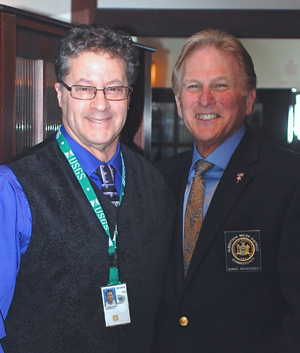
Terracciano with AbbondondeloAt a recent Nassau Suffolk Water Commissioners’ Association (NSWCA) meeting, Stephen Terracciano, Office Chief of the U.S. Geological Survey (USGS) program, spoke about the USGS’ mission and latest findings regarding Long Island’s water supply. The meeting was hosted by Roslyn Water District Commissioners Michael J. Kosinski, William Costigan, and Dr. Sanford E. Klein.

“Data indicates that urbanization of western Long Island has had a significant effect on the underlying water resources,” stated Mr. Terracciano.  “Installation of sewers and storm drains, along with large scale pumpage, has caused significant declines in water levels.  This has led to reduction in streamflow, loss of wetlands, saltwater intrusion, basement and subway flooding.”

Water resources are affected by many factors, both natural and man-made, including climate change, storms, population growth and land-use.  On Long Island, the USGS collects hydrologic data through a network of stations that monitor wells, streams, lakes, estuaries and meteorological posts. This data is collected, organized and used to identify trends and influences on the water system including water supply, salt water intrusion, climate, population, drought and flood monitoring.

NSWCA President Howard Abbondondelo of Albertson Water District remarked on the importance of the USGS studies.  “The data collected by the USGS is essential to the policy making that protects and manages our precious water resource.  Introducing the USGS to the newest members of NSWCA and reaffirming the importance of the organization’s work is part of NSWCA’s ongoing educational program and initiatives.”

A national science-based organization, the U.S. Geological Survey has provided the public with impartial information on the health of our environment, ecosystems and natural resources, including water supply, for over 100 years.  On Long Island, the organization is currently sustained by a shared funding program to which the NSWCA has supported and contributed $50,000.

For further information, contact NSWCA President Howard Abbondondelo via phone, (516) 621-3610 or email, awd11577@optonline.net.

Agency Contact, or for information regarding your district’s water commissioners, contact  Mr. Jamie Stanco with Progressive Marketing Group, Inc. via phone, (631) 756-7160 or email, jpstanco@pmgstrategic.com

Photo Caption:  Pictured left to right: Stephen Terracciano, Office Chief of the U.S. Geological Survey (USGS), and NSWCA President Howard Abbondondelo of Albertson Water District.   

Water supply shutdown in Charleston. Why it can’t happen on Long Island.

February 21, 2014 – Albertson, New York ………………………….The plight of Charleston West Virginia residents has largely been rectified, but not until after some 300,000 people were without water for up to 21 days.  7,500 gallons of crude methylcyclohexane methanol or MCHM, a chemical used in coal processing, leaked from a massive storage container into the Elk River, contaminating the area’s main source of drinking water.  The spill from the Freedom Industries plant was dangerous and eye opening, but concerned Long Island residents should be aware that such an event is virtually impossible in Nassau and Suffolk Counties.

The differences lie in hydrogeology and water system management.  Charleston, West Virginia’s Capitol, is nestled in the Kanawha Valley at the confluence of the Elk and Kanawha Rivers, a center for chemical, coal, and other industries.  “Our situation here on Long Island is much different to Charleston, starting with how we get our water in the first place,” stated Howard Abbondondelo, NSWCA President and Albertson Water Commissioner.  Charleston’s water source is surface water provided by the Elk River.  In Nassau and Suffolk, our source of water is groundwater primarily drawn from the Magothy Aquifer and the depth in most locations is hundreds of feet below the ground surface.”

Surface water is highly susceptible to contamination from storm water runoff and wastewater treatment plant discharges, as well as spills and leaks of hazardous substances.  In many cases, there is a short flow travel time between the point of contamination and the sole municipal potable water intake.  Long Island’s water suppliers, including the 21 Commissioner-run districts represented by the NSWCA, directly manage a multiplicity of wells and test and monitor groundwater with regularity.

“With numerous wells spread out across the Island, the chances for a pandemic situation or shutdown as occurred in Charleston are remote,” NSWCA First Vice President and Massapequa Water Commissioner Tom Hand observed.  “By themselves, the 21 districts account for approximately 220 wells.  This is in addition to wells serving the two cities (Glen Cove and Long Beach), numerous villages, three private water companies and the Suffolk County Water Authority.  The total number of public water supply wells located throughout Nassau and Suffolk Counties is estimated to be in excess of 1,000.”

Storm-driven disasters could potentially affect delivery for Long Island residents.  However, even Superstorm Sandy did not stop water delivery.  In fact, no Commissioner-run district had an interruption in water supply during or after the storm.

“That’s due to meticulous preparation,” Massapequa Commissioner Raymond J. Averna stated.  “Our Districts are prepared for such events. We all have standby power and direct drive engines or generators to keep water flowing to homes and businesses. In addition, there are numerous interconnections to allow for the transfer of water between adjacent suppliers.  And, we all owe a great deal of gratitude to Long Island water district operators and crews who maintain our systems.”

Another reason why the likelihood for an island-wide water shutdown is slim is the testing and security that originate with concerned professional management. The Environmental Protection Agency (EPA) has stringent requirements and the New York State Department of Health (NYDOH) and the Nassau and Suffolk County Health Departments are diligent in their enforcement of regulations.  The day-in, day-out involvement by water districts on the local level, specifically monitoring, inspection and continual testing, help to ensure the cleanest and highest quality water possible.

By and large, Long Island water is of enviable quality.  However, where required, treatment is provided to achieve a supply that complies with stringent regulatory requirement. “Our aquifers constitute a vast resource that needs to be monitored carefully and managed scientifically on a daily basis,” President Abbondondelo affirmed. “This is necessary to prevent potential disasters like what happened in Charleston West Virginia. All our efforts are designed to preserve the excellent quality of our water, and to minimize costs to Long Island consumers whose daily lives depend on it.”


 

New 2014 Board Elected

At a recent Nassau Suffolk Water Commissioners Association (NSWCA) meeting sponsored by the Plainview Water District, the Association elected a new board for the 2014 term.  The term of service for NSWCA’s new board members runs January 1, 2014 through December 31, 2014.

The newly elected 2013 Board includes:

  • President: Howard Abbondondelo of Albertson Water District
  • 1st Vice President: Thomas P. Hand of Massapequa Water District
  • 2nd Vice President: Raymond J. Averna of Massapequa Water District
  • Treasurer:   Karl Schweitzer of Hicksville Water District, a past NSWCA President
  • Secretary:  Andrew N. Bader of Plainview Water District

Saving Dollars and Supporting Changes To Revised Federal Water Regulations

January 8, 2014, Melville, NY USA – The Nassau Suffolk Water Commissioners’ Association (NSWCA) applauds the good judgment demonstrated by the Environmental Protection Agency (EPA) and the strong leadership of Senator Charles Schumer (D-N.Y.) regarding the Community Fire Safety Act of 2013, which has resulted in an exemption for fire hydrants.

The Act, which amends the 2011 Reduction of Drinking Water Act, was intended to reduce the potential for lead in drinking water by establishing lower lead thresholds, a position supported by major groups including the NSWCA. As of January 4, 2014, the amount of lead in fittings, pipes and fixtures will be significantly reduced.

The original bill was essentially based on California and Vermont laws that explicitly exempt fire hydrants. However, in late October 2013, the EPA indicated that fire hydrants, even though they are not intended for drinking water, were not exempt.  To comply, water districts on Long Island and across the nation would no longer be able to use stockpiled replacement hydrants, and would be compelled to purchase reduced lead fire hydrants. The new exemption changes that.

NSWCA President Howard Abbondondelo commented, “All 21 of our commissioner-run member districts have stockpiles of hydrants for emergency, expansion and projected future maintenance needs. The savings to water districts in Nassau and Suffolk realized by this exemption could run into the millions of dollars, in addition to savings of time and labor.”

The U.S. Senate passed the bill unanimously, as did the U.S. House of Representatives, 384-0 and President Obama signed it into law. The American Water Works Association (AWWA) called it “a tremendous victory for the water sector, our communities and common sense.”

NSWCA President Abbondondelo, also a Commissioner from Albertson, added “considering that Long Island water districts are constantly seeking to contain costs in order to continue to keep Long Island’s average per 1,000 gallon pricing among the lowest rates in the USA, this development is great news for all Long Island ratepayers.”

NSWCA 1st Vice President Thomas Hand, a Commissioner from Massapequa commented,  “We are very pleased with the united front and the determined bipartisan leadership that has enabled this to come to pass.  It’s a positive outcome for all.”

The Value Of Commissioner-Run Districts

Working together for the common good of all Long Islanders

We, the Nassau Suffolk Water Commissioners’ Association (NSWCA), commend the recent Newsday/News 12 efforts to inform and educate the public regarding Long Island’s most valuable resource, our single source water supply.

As an association composed of professionals closest to Long Island’s water realities, few understand the intricacies of water production, delivery, conservation and sustainability more than we do. Having been charged with keeping our water safe and affordable, maintaining a plentiful supply and guaranteeing efficient service, we, the independent commissioner-operated districts, are the stewards who represent the people, our consumers, each and every day, without exception.

For the better part of a century, Long Island’s independent commissioner-elected water districts have represented their ratepayers and constituents with vigilance and dedication.  As the Newsday/News 12 articles illustrate, this has resulted in Long Island’s average cost of drinking water being one of the lowest costs in the nation.  The proactive infrastructure upgrading policies of the independent districts associated with the NSWCA have served taxpayers well in other ways.  Most notably, when Superstorm Sandy carved a wide swath of destruction, not a single commissioner-led water district experienced an interruption in service, thanks to the dedicated crews who are local to their communities, and who steadfastly defended their districts.

It should be pointed out that today, the safety of our sole source aquifer and water supply systems must be guarded not only against pollution, overuse and salt water intrusion, but also against potential terrorist activities. This necessitates close working arrangements between government agencies, regulatory bodies, suppliers and the public…a policy heartily endorsed by the members of the NSWCA.

The concept of popular election of local commissioners in locally-run water utilities is as American as apple pie, harkening back to the New England town meetings. The NSWCA believes that having a direct say by voting for men and women who live in the same community, share the same concerns and utilize the same water, is the best way to guarantee safety for all.

We believe in comprehensive, hands-on vigilance and in fighting the good fight, dealing head on with tough environmental issues so many of which are legacies of the WWII and Cold War eras.  We believe in open, honest collaboration with local, state and federal governments.  And we believe in education and outreach to inform the public and to guide them as our neighbors, to help them to genuinely endorse and adopt a fundamental best practices outlook for every community on Long Island.

And we believe that because water is the most essential of all resources, Long Island’s aquifers must be defended with science and a passion for the benefit of our children’s childrens’ children.  We, the Nassau Suffolk Water Commissioners’ Association (NSWCA), representing 21 independently elected districts, maintain that anything less is unacceptable, and we will not settle for less in our respective communities.

– Gary F. Brosnan, President, Nassau Suffolk Water Commissioners’ Association and Water Commissioner, South Farmingdale Water District